
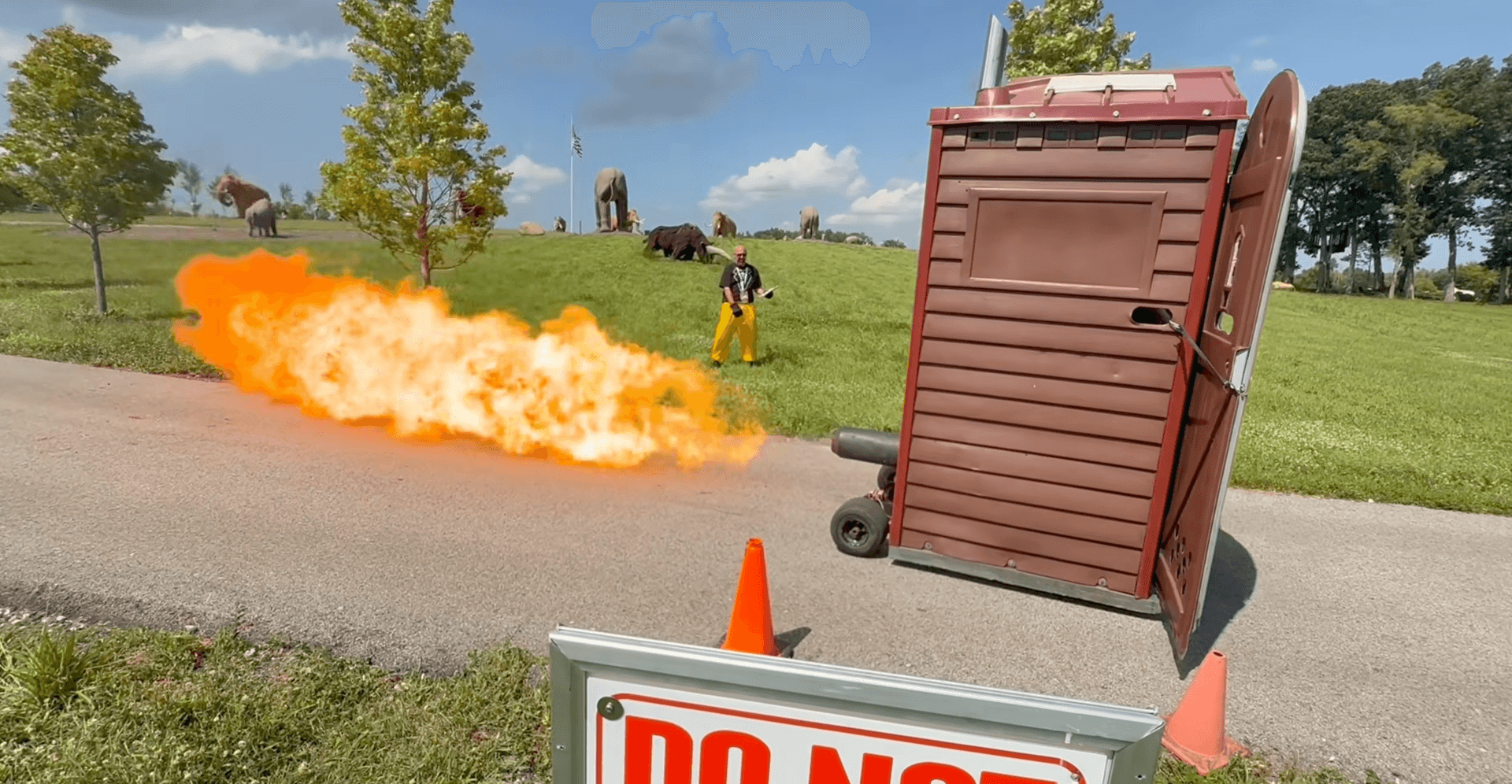
Naturally, we came up with the worst possible solution.
Instead of following years of automotive engineering, scientific research, or basic common sense, we decided to invent our own alternative fuel system. If the biggest automakers in the world could spend billions of dollars developing cleaner transportation, surely two guys with questionable judgment, a camera, and way too much confidence could build something just as revolutionary… right?
That was the beginning of what we proudly named the Portable Organic Output Propulsion Shuttle, or POOPS for short.
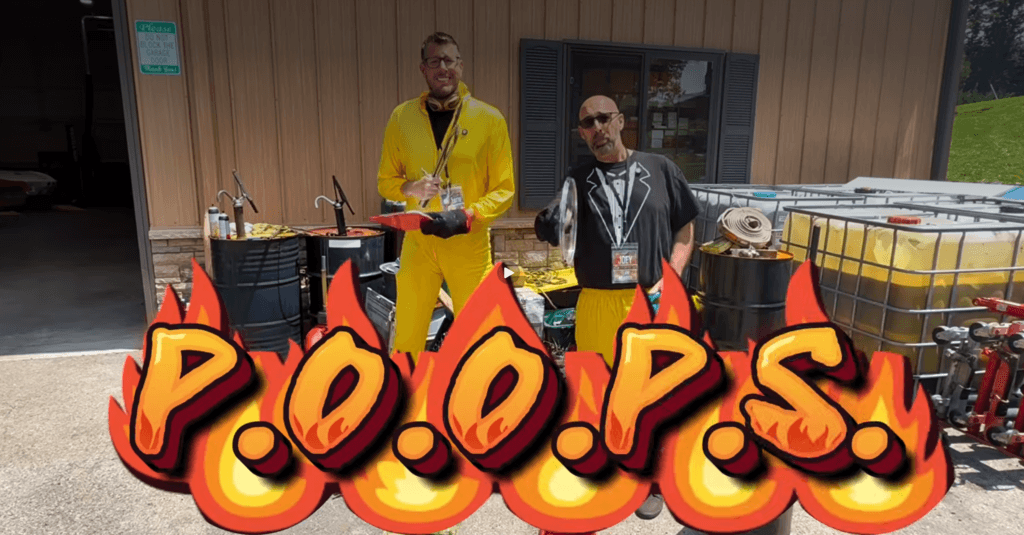
Every groundbreaking invention deserves a memorable name, and this one certainly delivered.
Our goal wasn’t necessarily to create the cleanest vehicle. It wasn’t designed to be efficient, environmentally friendly, or practical in any measurable way. In fact, if you asked whether it was based on science, we’d probably have to politely change the subject. What it did have going for it was an unlimited supply of renewable “fuel” and an idea so ridiculous that we simply had to see it through.
Every engineering project begins with identifying a problem, and ours quickly became obvious: we needed fuel.
Fortunately, obtaining fuel wasn’t nearly as complicated as building the propulsion system itself. We didn’t need to drill for oil, refine gasoline, or charge an expensive battery pack. Instead, we made a quick stop at what might be the world’s most unconventional fueling station—a fast-food drive-thru.
After carefully reviewing the menu with all the seriousness of aerospace engineers planning a moon mission, we settled on a couple of Number Eights. To maximize the output potential, we naturally added extra fire sauce. Scientific? Probably not. Delicious? Absolutely. Necessary for the experiment? We were willing to argue yes.
Of course, every fuel collection mission requires proper storage. That’s when we realized we’d overlooked one small detail: we didn’t actually have a container.
The solution? Jim’s lunchbox.
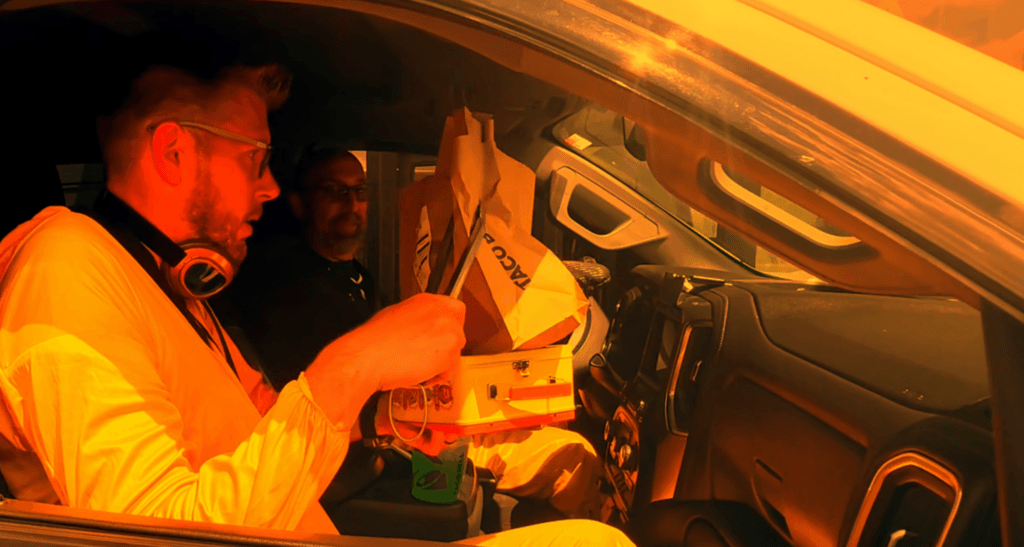
Was it designed for this purpose? Definitely not. Did it still contain his lunch? Unfortunately, yes. Did that stop us? Not even a little.
True innovation often involves making sacrifices, and apparently Jim’s lunch was one of them.
With our fuel acquired and securely stored, it was finally time to return to the workshop. This was the part where everything suddenly started to feel much more official. Clipboards appeared. Inspections were conducted. Various components were poked, tightened, and nodded at approvingly. Whether or not any of it actually mattered was beside the point—it looked incredibly professional on camera.
Every great invention has a moment where the creators stand back, admire their work, and convince themselves everything is perfectly safe. We experienced that exact moment… for about three seconds.
The Portable Organic Output Propulsion Shuttle stood before us in all its questionable glory. It looked equal parts homemade science project and something your insurance company would immediately refuse to cover. Yet somehow, we couldn’t help feeling proud.
There was only one thing left to do.
Somebody had to test it.
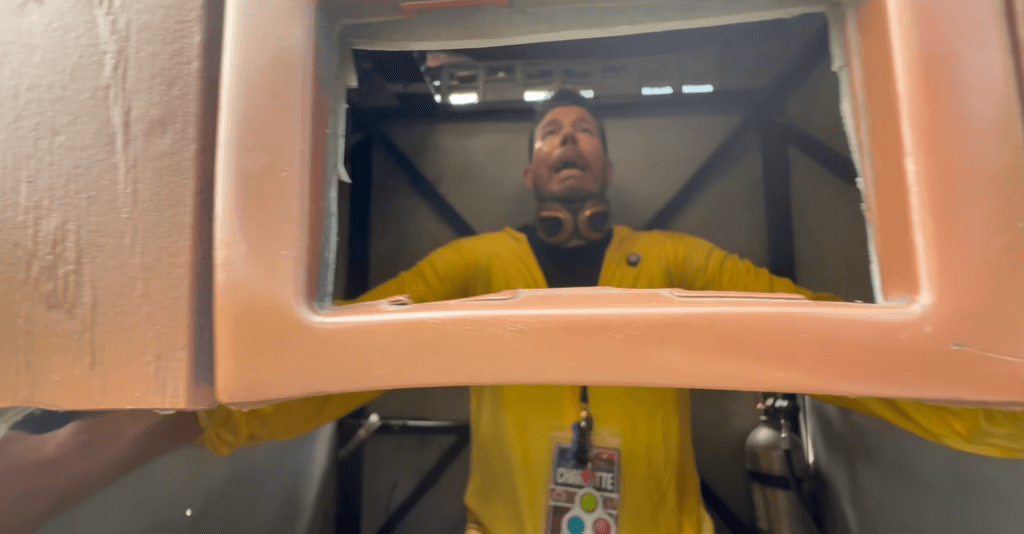
As our brave volunteer climbed aboard, the atmosphere shifted from excitement to just a tiny bit of concern. Sitting inside the machine, he began looking around the cockpit for anything resembling controls. Thankfully, there were controls. Whether they made sense was another matter entirely.
One switch was labeled Start.
Another was labeled Don’t Touch That One.
That’s exactly the kind of labeling that inspires confidence.
After a brief discussion about whether or not we should ignore the obvious warning, we proceeded exactly as responsible engineers would.
Of Course We pushed the button.

At first, everything seemed promising. Strange noises echoed through the machine. There were mysterious bubbles, unexpected vibrations, and enough strange sounds to convince us that something important was definitely happening. Whether that something was progress or impending disaster remained unclear.
Then things escalated.
Very quickly.
Instead of a smooth ignition sequence, we unleashed what could only be described as the angry fire of Hades itself. Flames erupted with surprising enthusiasm as everyone involved suddenly discovered a much deeper appreciation for personal safety.
Panic replaced confidence almost instantly.
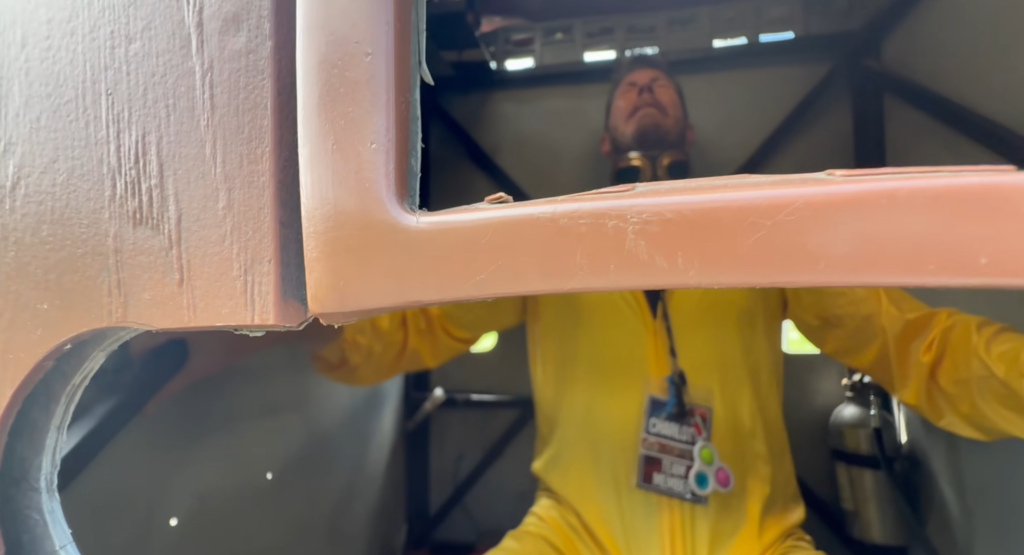
There was yelling. There was screaming. There was running.
There may have even been a brief moment where everyone involved reconsidered every decision that had led us to this exact point in history.
Oddly enough, despite the complete lack of control, the propulsion system actually worked… sort of.
The machine moved.
Momentum happened.
Physics did what physics does, regardless of whether anyone understands it.
By some miracle—or perhaps because comedy has its own laws of nature—the test was successful enough that we could confidently declare victory.
Against all odds, we’d done it.
Standing there after the smoke cleared, we shared the unmistakable satisfaction that comes from surviving an idea that absolutely should not have worked. Engineers throughout history have celebrated their breakthroughs, from the Wright brothers achieving powered flight to NASA landing on the moon.
Our accomplishment wasn’t quite on that level.
But emotionally?
It felt close.
As we admired our creation, someone proudly announced that we’d solved the world’s energy crisis. It was an ambitious claim, supported by absolutely zero evidence, but after everything we’d just experienced, it somehow felt earned.
Of course, reality eventually returned.
The future of transportation probably isn’t powered by whatever we had just created. Electric vehicles are still likely the better long-term solution. Hydrogen technology continues to improve. Renewable energy keeps advancing. Scientists all over the world are working tirelessly to build a cleaner future.
Meanwhile, we built POOPS.
And honestly, we’re okay with that.
Not every project has to revolutionize the world. Sometimes the goal is simply to create something so absurd that people can’t stop laughing. There’s something uniquely satisfying about taking an everyday problem—like expensive gasoline—and solving it in the most unnecessarily complicated and hilariously impractical way imaginable.
That’s always been part of what makes projects like this so much fun. They’re not really about finding real solutions. They’re about asking, “What if?” and then following that question far beyond the point where common sense would normally tell you to stop.
Because those are usually the adventures worth remembering.
If nothing else, the Portable Organic Output Propulsion Shuttle proved one important lesson: creativity doesn’t always have to be practical. Sometimes it just has to be entertaining.

Would we recommend replacing your car’s fuel system with our revolutionary invention?
Absolutely not.
Would we build something equally ridiculous again?
Without hesitation.
After all, somebody has to keep pushing the boundaries of bad ideas.
And if those bad ideas happen to make people laugh along the way, we’d call that a successful experiment.
This energy crisis parody asks one very important question: what happens when Brian and Jim try to solve rising fuel costs with a homemade invention, questionable engineering, and a truly ridiculous alternative fuel idea?
The result is POOPS, the Portable Organic Output Propulsion Shuttle, a comedy experiment that proves not every solution to the energy crisis should be taken seriously.